 Fami
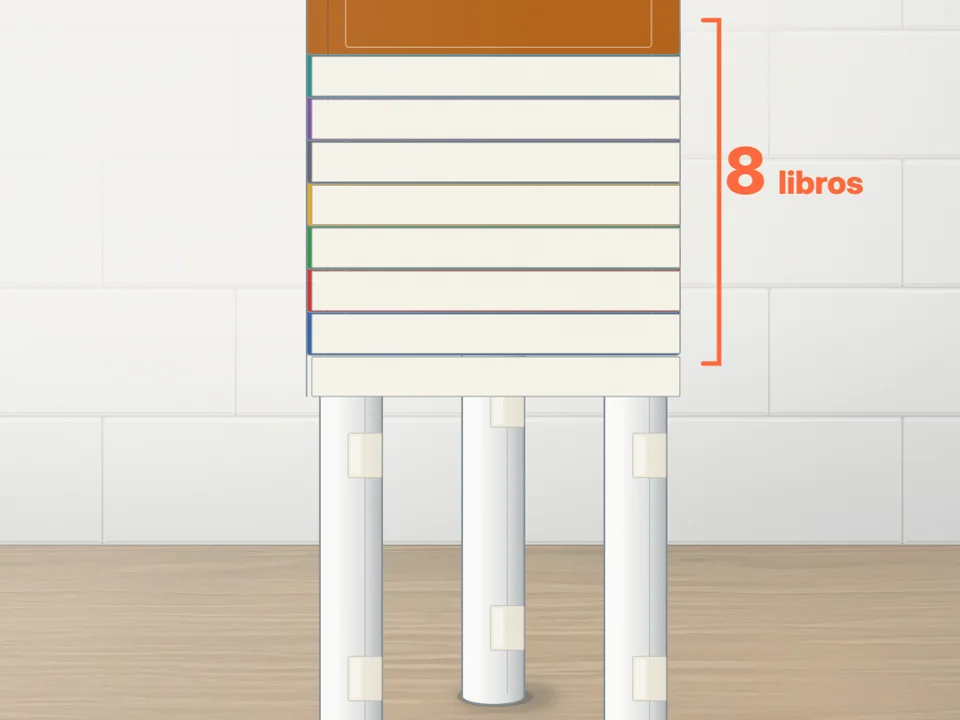
Paper columns that hold up books
Roll three sheets of paper, stand them up and find out how many books paper can hold.
Materials
- 3A4 sheets of paperor Magazine or newspaper pages
- 1Sticky tapeor A glue stick
- 8 or moreBooksor Bags of rice or pasta
Step by step
- 1
Stand a sheet of paper on the table
It can't even hold itself up: it bends and falls
- 2
Roll a sheet along its short side and tape it
A tight tube, closed with 2 bits of tape
- 3
Make 3 tubes the same
Roll them all equally tight
- 4
Stand them up in a triangle
Spaced out, like the legs of a stool
- 5
Rest 1 book on top, slowly
Centred, so the weight falls on all 3 tubes
- 6
Add books 1 at a time and count
Until a column bends. How many do they hold?
Result
3 sheets hold up 8 books!
Why does it happen?
Standing up, a flat sheet bends anywhere if you so much as look at it. Rolled up, the weight travels down spread over the whole wall of the tube, and there is no corner or edge where it can start to bend. That is why the columns of buildings and lamp posts are round or tubular. In our test they held 8 books; write down how many yours hold and try tighter or wider tubes.
For parents
The science, so you can answer
Shape matters more than material: the same sheet, rolled into a tube, holds far more weight.
A column rarely fails by being crushed; it fails by bending sideways, which engineers call buckling. A flat sheet bends at the slightest load because it is thin in one direction. Rolled up, the paper sits all around the centre at the same distance on every side, so there is no easy way to bend; and the weight travels down the whole wall of the tube at once. With three legs in a triangle, the top never wobbles and the weight is shared between all three.
What they will ask you
«Why does a standing sheet fall by itself?»
Because it is so thin it bends anywhere under its own weight.
«Why does the tube hold so much if it is the same paper?»
Because the paper surrounds the centre on every side and has nowhere to start bending. The weight spreads round the whole wall.
«Why does it give way in the middle?»
It is the point furthest from the ends, which are held in place; there the column is freest to bend.
«Why three legs and not two or four?»
Two would topple; three always all touch, even on an uneven floor, like a tripod. Four works too, but it can wobble.
In real life: Temple columns, scaffolding poles, bicycle frames and our own long bones (hollow inside) all use this same trick.
Animated step by step
Follow it with your phone on the table: it pauses at the end of each step.